Toyota 4Runner Review Hybrid Power Meets Rugged Technology


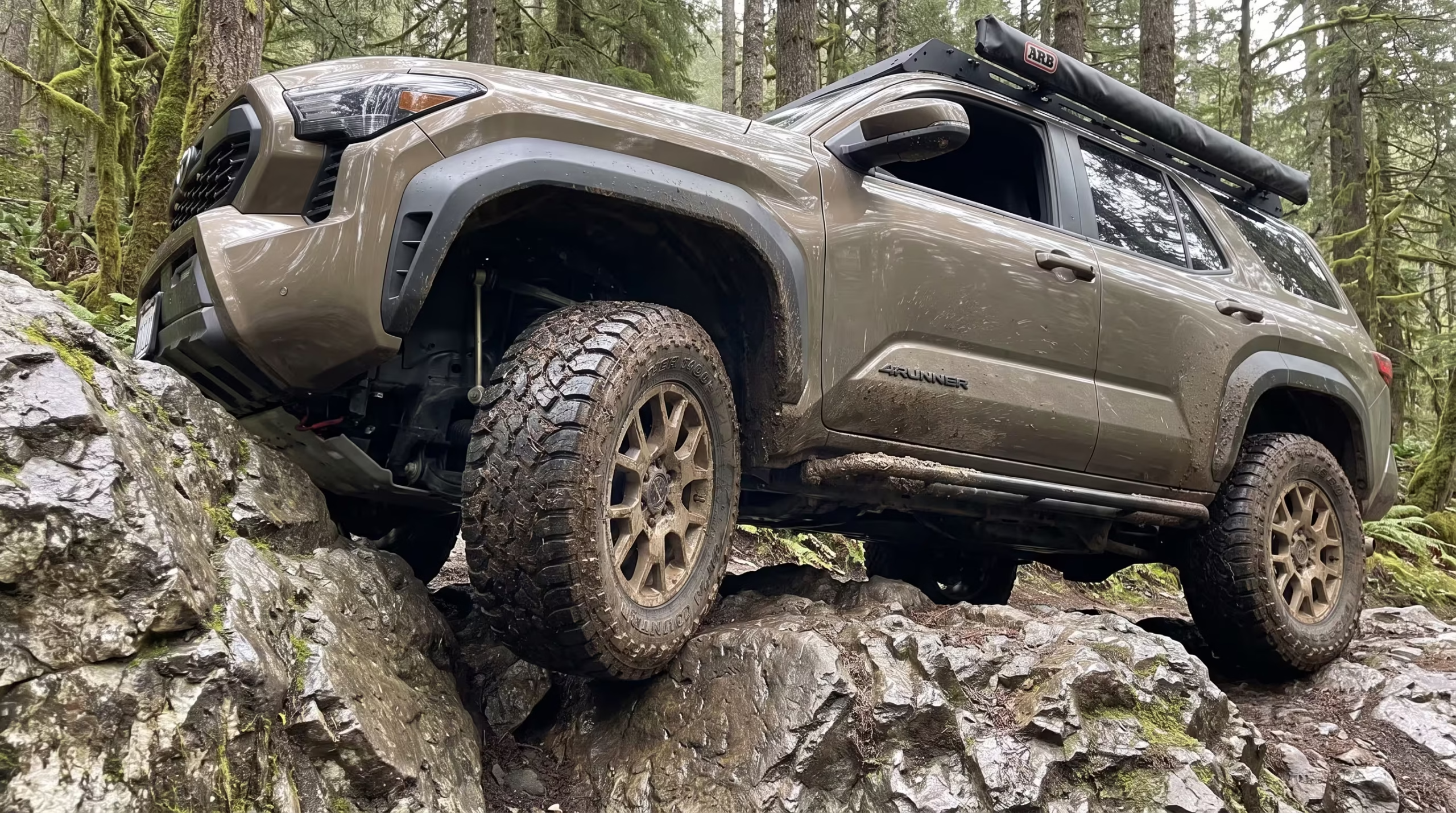


The Toyota 4Runner has entered a new era without abandoning the rugged personality that made it an off-road icon. Built on a newer truck platform, the sixth-generation SUV brings turbocharged power, an available hybrid system, improved road manners and a far more advanced cabin. Modern cars now have to balance performance, efficiency, safety and connectivity, and this redesigned 4Runner makes its biggest technological leap in decades.
What Makes a Vehicle Modern?
A modern car is not defined by a large touchscreen alone. It combines efficient powertrain engineering, intelligent driver assistance, connected infotainment, digital information displays and practical software-supported features in a package that remains easy to use.
The Toyota 4Runner is still a traditional body-on-frame SUV, but it now includes technology normally associated with newer crossovers. The previous generation used a naturally aspirated 4.0-liter V6 and five-speed automatic transmission. The current model replaces that formula with an eight-speed automatic, turbocharged engines, available hybrid assistance and a modern electronic architecture.
Toyota 4Runner Platform and Chassis
The 4Runner rides on Toyota’s TNGA-F global truck platform, which is also used by the Tacoma, Land Cruiser, Tundra and Sequoia. Its high-strength boxed steel ladder frame is paired with a double-wishbone front suspension and a multi-link coil-spring rear suspension. Aluminum is used in parts of the upper body to help manage weight.
This foundation allows different trims to have distinct personalities. The TRD Sport receives road-focused suspension tuning, TRD Off-Road models use Bilstein hardware, TRD Pro adds adjustable FOX internal-bypass shocks, and Trailhunter uses Old Man Emu forged monotube shocks developed for overlanding. Limited and Platinum models offer Adaptive Variable Suspension for a smoother on-road experience.
Toyota also preserves the power-retractable rear window. It remains useful for loading long items, improving low-speed ventilation and giving the SUV a feature that few competitors offer.
Toyota 4Runner Engine Options and Performance
Two 2.4-liter turbocharged four-cylinder powertrains replace the previous 4.0-liter V6. Both use an eight-speed automatic transmission and produce considerably more torque than the outgoing engine.

Standard i-FORCE Turbo Engine
The standard i-FORCE engine produces 278 horsepower and 317 lb-ft of torque. It powers mainstream trims such as SR5, TRD Sport and TRD Sport Premium, while remaining available on selected TRD Off-Road and Limited configurations.
In daily driving, the turbo engine should feel more responsive because strong torque is available without revving as hard as the old V6. Highway merging, passing and climbing grades feel less strained. However, drivers familiar with the older model may notice more transmission activity and a less linear power delivery.
i-FORCE MAX Hybrid Powertrain
The available i-FORCE MAX combines the turbo engine with a 48-horsepower electric motor integrated into the transmission. A 1.87-kWh nickel-metal hydride battery supports a combined output of 326 horsepower and 465 lb-ft of torque. The system is standard on TRD Pro, Trailhunter and Platinum, and available on TRD Off-Road, TRD Off-Road Premium and Limited.
This is a performance-oriented hybrid, not a plug-in hybrid. The SUV has no externally chargeable battery, published electric-only range or DC fast-charging capability. Regenerative braking and the gasoline engine recharge the compact battery automatically, so charging speed and home charging time do not apply.
Key Specifications
| Specification | Standard i-FORCE | i-FORCE MAX Hybrid |
|---|---|---|
| Engine | 2.4-liter turbo inline-four | 2.4-liter turbo inline-four with electric motor |
| Transmission | 8-speed automatic | 8-speed automatic |
| Horsepower | 278 hp | 326 combined hp |
| Torque | 317 lb-ft | 465 lb-ft |
| Hybrid battery | Not applicable | 1.87-kWh NiMH |
| Drivetrain availability | 2WD or 4WD, depending on trim | 4WD |
| Maximum towing capacity | Up to 6,000 lb | Up to 6,000 lb |
| Best estimated highway economy | Up to 26 mpg | Up to 24 mpg |
| External charging | Not applicable | Not required |
| Maximum seating | Up to seven | Configuration dependent |
It can tow up to 6,000 pounds, improving on the previous generation’s 5,000-pound maximum. Available towing technology includes a trailer brake controller, digital rearview mirror and Trailer Back-Up Guide with Straight Path Assist.
Fuel Economy and Efficiency
Fuel economy varies by trim, drivetrain, tires and equipment. Current estimates reach 20 mpg city and 26 mpg highway for selected standard-engine models. Several hybrid configurations are rated at 23 mpg city and 24 mpg highway, while some off-road gas models are listed at 19 mpg city and 25 mpg highway.
Those numbers improve on the older V6 model, although the 4Runner remains a heavy, upright SUV designed for difficult terrain. Real-world economy will be affected by all-terrain tires, roof racks, cargo weight, towing, elevation, temperature and driving speed. Buyers should view the hybrid mainly as a high-torque electrified powertrain rather than an economy-first system.

Driving Experience and Real-World Usability
The latest 4Runner feels more controlled on pavement because of its stiffer platform, electric power steering, modern suspension geometry and stronger braking performance. Steering response is more precise, body movement is better managed and the eight-speed transmission keeps the engine closer to its useful torque range.
Nevertheless, it remains a truck-based SUV. Large all-terrain tires, off-road shocks and extra ride height can create more road noise and low-speed firmness than a car-based crossover. TRD Pro and Trailhunter prioritize trail performance, while Limited and Platinum better suit drivers who spend most of their time on highways and city streets.
Cabin usefulness remains a major strength. An available third row adds flexibility, although it is best for occasional passengers. The second row gains tumble-folding functionality, but passenger space may still feel less generous than in some family-oriented three-row crossovers. The retractable rear glass, practical cargo area and available power outlets make the vehicle especially useful for camping, pets and outdoor equipment. Hybrid versions include a 2,400-watt AC power supply in the cabin and cargo area.

Interior Technology and Connectivity
The entry multimedia system uses an 8-inch touchscreen, while higher trims offer a 14-inch Toyota Audio Multimedia display. Wireless Apple CarPlay and Android Auto are supported, and USB-C charging points are available throughout the cabin. A 12.3-inch digital gauge cluster is standard on all i-FORCE MAX models and included on selected upper trims.
Available technology includes:
- Qi wireless phone charging
- Digital Key compatibility
- Credit-card-sized Card Key
- 14-speaker JBL premium audio
- Removable JBL FLEX Bluetooth speaker
- Panoramic View Monitor
- Multi-Terrain Monitor
- Head-Up Display on Platinum
- Connected remote functions with an eligible subscription
Physical controls remain central to the dashboard. Large climate and drive-mode controls are easier to operate on rough roads than touchscreen-only interfaces, helping the cabin feel modern without becoming unnecessarily complicated.
Off-Road Technology and Capability
The 4Runner continues to separate itself from ordinary crossovers through genuine low-range four-wheel-drive hardware. Depending on trim, available systems include Multi-Terrain Select, CRAWL Control, Downhill Assist Control, Active Traction Control and an electronically locking rear differential.
TRD Pro and Trailhunter include a Stabilizer Disconnect Mechanism that increases suspension articulation at the push of a button. It is also optional on the i-FORCE MAX TRD Off-Road Premium. Trailhunter adds 33-inch Toyo tires, an onboard air compressor, a high-mounted air intake, an ARB roof rack and integrated auxiliary lighting.
This equipment makes the 4Runner more than an SUV with rugged styling. It is engineered for loose surfaces, steep descents, uneven trails and low-speed technical driving. The hybrid’s 465 lb-ft of torque should be particularly useful when climbing, towing or carrying heavy gear.

Driver-Assistance and Safety Features
Every 2026 model includes Toyota Safety Sense 3.0. The suite contains a Pre-Collision System with Pedestrian Detection, Lane Departure Alert with Steering Assist, Full-Speed Range Dynamic Radar Cruise Control, Lane Tracing Assist, Road Sign Assist, Automatic High Beams and Proactive Driving Assist. Blind Spot Monitor and Rear Cross-Traffic Alert are also offered.
The updated sensor package can recognize additional road users and support smoother adaptive cruise operation. However, these remain assistance features rather than autonomous-driving technology. Their purpose is to reduce workload and add another layer of awareness during commuting, highway travel and parking.
Pricing, Warranty and Ownership Costs
The 2026 Toyota 4Runner currently starts at $42,070, excluding delivery, taxes, registration and optional equipment. The lineup spans 12 gas and electrified configurations, with the TRD Pro listed at $68,400 before destination and extras.
Ownership costs will vary considerably. Standard turbo models cost less to purchase, while hybrid and specialized off-road trims include more complex hardware, larger tires and potentially more expensive replacement parts. Aggressive all-terrain tires may also wear faster and reduce fuel economy compared with road-focused tires.
Toyota provides a 3-year/36,000-mile basic warranty and a 5-year/60,000-mile powertrain warranty. Hybrid components receive 8-year/100,000-mile coverage, while the hybrid battery is covered for 10 years or 150,000 miles. ToyotaCare covers scheduled maintenance for 2 years or 25,000 miles and roadside assistance for 2 years with unlimited mileage.

Comparison With the Previous 4Runner
The fifth-generation model built its reputation on durability, simplicity and strong off-road ability, but its 270-horsepower V6, five-speed automatic and 5,000-pound tow rating increasingly felt dated beside newer rivals.
The new generation delivers:
- More horsepower and substantially more torque
- An available hybrid off-road SUV powertrain
- A 6,000-pound maximum tow rating
- Improved estimated fuel economy
- More precise steering and stronger chassis control
- Larger infotainment displays
- An available digital gauge cluster
- A broader active-safety package
- More specialized luxury and overlanding trims
The trade-off is complexity. Turbocharging, hybrid components, adaptive suspension and additional electronics may concern buyers who valued the previous vehicle’s mechanical simplicity. Even so, the redesigned SUV is far more competitive as a daily driver.
Toyota 4Runner vs Key Competitors
The Ford Bronco and Jeep Wrangler are the clearest alternatives for buyers prioritizing serious trail capability and open-air driving. Both offer removable doors and roof options, features the fixed-roof 4Runner does not provide.
In return, Toyota’s SUV offers a more conventional enclosed cargo area, its unusual retractable rear window and a broad selection of road, luxury and overlanding configurations. The related Land Cruiser has a more heritage-luxury position, while many unibody midsize SUVs place greater emphasis on soft road manners and passenger packaging.
The strongest argument for the 4Runner is its range of personalities. Buyers can choose an accessible SR5, a road-oriented Limited, a premium Platinum, a trail-focused TRD Pro or a factory-equipped Trailhunter overlander.
Market Impact and Future Direction
The redesigned 4Runner shows how a modern vehicle can evolve without abandoning its original purpose. Instead of turning the nameplate into a soft crossover or full battery-electric SUV, Toyota uses a modular truck platform, downsized turbocharging and hybrid torque to preserve capability while improving performance and cabin technology.
This formula points toward the future of rugged SUVs: more electrified assistance, integrated trail cameras, smarter towing aids, digital access and software-based drive modes. The current lineup contains gas and conventional hybrid configurations, not a plug-in hybrid or battery-electric version. Buyers should therefore not assume an EV model or electric range until Toyota confirms one.
Is the Toyota 4Runner Worth Buying?
The Toyota 4Runner is worth considering for buyers who genuinely need off-road capability, towing strength, cargo flexibility and durable truck-based construction. The standard i-FORCE engine offers the lower-cost route, while i-FORCE MAX is the stronger choice for drivers seeking maximum torque, standard four-wheel drive and premium trail equipment.
It is less suitable for shoppers focused mainly on spacious third-row seating, sports-car-like handling or class-leading fuel economy. However, as a modern adventure SUV that can commute during the week and handle difficult terrain on weekends, the 4Runner is more complete than ever.
The sixth-generation 4Runner successfully modernizes a proven formula. Its turbo and hybrid engines provide stronger torque, the TNGA-F platform improves control, and the updated cabin finally delivers current infotainment and safety technology. Fuel economy and rear-seat space remain compromises, but few SUVs combine towing, low-range four-wheel drive, factory off-road hardware and everyday practicality in such a recognizable package.