Xiaomi Mi Electric Scooter Pro 2 Review Range, Specs & Value


The Xiaomi Mi Electric Scooter Pro 2 is a practical urban commuter built around a simple idea: provide enough range, performance, portability, and connected technology for everyday city travel without turning an electric scooter into a heavy performance machine. Its 300W rated motor, 446Wh battery, folding aluminum frame, pneumatic tires, and 25 km/h top speed created a well-balanced package that remains relevant when evaluating used or refurbished commuter scooters today.
Electric scooters have become an important part of modern urban mobility because they can fill the gap between walking, cycling, public transport, and driving. The best commuter models are compact enough for apartments and offices while providing enough riding range to make short urban journeys genuinely practical.
Xiaomi Mi Electric Scooter Pro 2 Key Specifications
The Xiaomi Mi Electric Scooter Pro 2 sits above lightweight entry-level scooters such as the Mi Electric Scooter 1S. Its larger battery and stronger motor make it better suited to longer daily journeys, although the additional battery capacity also increases weight.
| Specification | Xiaomi Mi Electric Scooter Pro 2 |
|---|---|
| Rated motor power | 300W |
| Maximum motor power | 600W |
| Maximum speed | 25 km/h / 15.5 mph |
| Claimed maximum range | 45 km / 28 miles |
| Battery capacity | 446Wh / 12,400mAh |
| Charging time | Approx. 8–9 hours |
| Tires | 8.5-inch pneumatic |
| Braking | E-ABS + rear disc brake |
| Suspension | None |
| Weight | 14.2 kg / 31.3 lb |
| Maximum load | 100 kg / 220 lb |
| Rated gradeability | 20% |
| Water resistance | IP54 |
| Headlight | 2W LED |
| Connectivity | Bluetooth / Mi Home app |
| Folding design | Yes |
What Is an Electric Scooter?
An electric scooter combines a rechargeable battery, electric motor, controller, throttle, standing deck, handlebars, wheels, and braking components into a compact personal transportation platform.
Several categories now exist:
- Commuter electric scooters prioritize range, predictable performance, and daily usability.
- Folding electric scooters emphasize portability and convenient storage.
- Lightweight city scooters reduce battery size and weight for short trips.
- Performance electric scooters use much more powerful motors, larger batteries, wider tires, and often suspension systems.
- Long-range models sacrifice some portability for substantially larger battery packs.
The Xiaomi Mi Electric Scooter Pro 2 combines commuter and folding-scooter characteristics. It was not designed for extreme speed or off-road riding; instead, its strengths are efficiency, compact storage, and straightforward city transportation.

Motor Power, Acceleration and Hill Performance
A 300W rated brushless DC motor drives the Xiaomi Mi Electric Scooter Pro 2, while maximum motor output is rated at 600W. Xiaomi also rates the scooter for gradients of up to 20% under appropriate conditions.
Acceleration is deliberately progressive rather than aggressive. That suits crowded urban environments where predictable throttle response is generally more useful than sudden bursts of torque.
Three main riding modes regulate performance:
- Pedestrian mode: up to 5 km/h
- Drive mode: up to 20 km/h
- Sport mode: up to 25 km/h

Sport mode delivers the strongest response, while Drive mode provides a useful middle ground for routine commuting.
The 300W motor is capable enough for moderate city gradients, but it should not be confused with modern dual-motor or high-output performance electric scooters designed around significantly more power.
Top Speed and Everyday Commuting
The maximum factory-rated speed is 25 km/h, or approximately 15.5 mph.
That figure may appear modest beside newer performance scooters, but speed alone does not determine commuter quality. At typical urban distances, predictable acceleration, battery efficiency, braking, maneuverability, and ease of storage often matter more.
The Xiaomi Mi Electric Scooter Pro 2 therefore feels most appropriate on relatively smooth cycle routes, paved urban roads, and short-to-medium city commutes.
Battery Capacity and Real-World Range
Battery capacity is one of the biggest reasons to choose the Xiaomi Mi Electric Scooter Pro 2 over Xiaomi’s smaller 1S.
The Pro 2 carries a 446Wh lithium-ion battery rated at 12,400mAh, compared with the 275Wh battery fitted to the 1S. Xiaomi’s official maximum range figure is 45 km, or around 28 miles.
However, maximum-range figures are laboratory-style estimates rather than a guaranteed commuting distance.
Actual electric scooter range changes with:
- Rider weight
- Average speed
- Acceleration frequency
- Hills and gradients
- Outdoor temperature
- Tire pressure
- Wind
- Surface conditions
- Battery age

Consequently, a rider repeatedly using Sport mode on a hilly route should expect less distance than the official maximum.
The real advantage is the commuting buffer provided by the larger battery. Riders with relatively short journeys may not need to recharge after every trip.
Charging Time and Battery Management
A full battery charge takes approximately 8–9 hours, which makes overnight charging the most convenient routine.
This charging speed is one area where the Xiaomi Mi Electric Scooter Pro 2 shows its age. Many newer electric scooters combine larger batteries with increasingly powerful charging systems.
However, Xiaomi included a fifth-generation battery management system that monitors battery condition and provides protection against conditions including short circuits, excessive current, overcharging, excessive discharge, abnormal temperature, and low-voltage storage. Battery information can also be monitored through the companion app.
Braking System
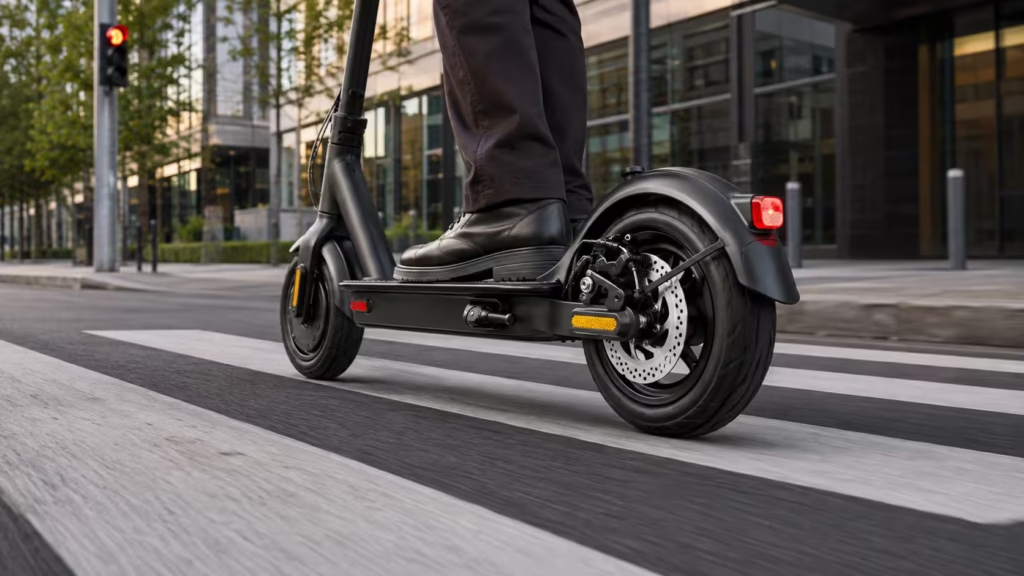
The Xiaomi Mi Electric Scooter Pro 2 combines an electronic regenerative braking system with a mechanical rear disc brake.
The E-ABS system handles electronic deceleration, while the disc brake provides physical stopping force.
This dual-system approach offers more controlled braking than relying entirely on a single electronic or mechanical system.
Regenerative braking also allows the motor to recover a limited amount of energy while slowing. It should be viewed primarily as an additional braking and efficiency feature rather than a major source of extra range.

Tires, Suspension and Ride Comfort
The scooter runs on 8.5-inch pneumatic tires front and rear.
Inflatable tires provide useful cushioning because the scooter has no dedicated mechanical suspension. On smooth asphalt, that combination works reasonably well and keeps the chassis simple.
Rougher surfaces expose the limitation quickly. Broken pavement, repeated cracks, cobblestones, gravel, and potholes transmit considerably more movement through the deck and handlebars than they would on a modern scooter with 10-inch tires and suspension.
Pneumatic tires also introduce additional maintenance because pressure must be monitored and inner tubes or tires can eventually develop punctures.
Frame Design, Folding and Portability
The Xiaomi Mi Electric Scooter Pro 2 weighs approximately 14.2 kg or 31.3 pounds.
That is light enough for occasional lifting into a vehicle, office, or apartment, but heavy enough that carrying it for long periods becomes inconvenient.
Its folding system allows the handlebar stem to collapse toward the rear wheel, substantially reducing its storage footprint. Refinements to the Pro 2 generation also resulted in a more rigid-feeling folding connection compared with earlier versions.
The frame remains one of the scooter’s strongest practical features. It feels more like a purpose-built commuter vehicle than a toy, while retaining the compact proportions that helped make Xiaomi’s folding scooter platform popular.

Display, App Connectivity and Smart Features
A multifunction dashboard sits centrally on the handlebars and displays information including speed, riding mode, Bluetooth connection, battery status, and lighting status.
Bluetooth connectivity links the Xiaomi Mi Electric Scooter Pro 2 with the Mi Home app.
Depending on region and firmware version, app functions can include battery monitoring, firmware management, regenerative-braking configuration, lighting preferences, locking functions, unit selection, and other scooter settings. Cruise-control availability has varied across regional software versions.
The electronic lock is primarily a convenience feature. When activated, it can introduce wheel resistance, lights, and an audible alert rather than functioning like a physical security lock.

Lighting, Visibility and Water Resistance
Visibility received meaningful attention on the Pro 2.
The scooter uses a 2W front LED headlight with a revised beam angle intended to illuminate the road without projecting excessive light upward. The rear light is larger and brighter than earlier versions, while front, side, and rear reflectors increase passive visibility.
The scooter also carries an IP54 rating, providing protection against limited dust and water ingress appropriate to its design category.
These refinements represent one of the clearest differences between the Pro 2 and earlier Xiaomi designs.
Xiaomi Mi Electric Scooter Pro 2 vs 1S vs Ninebot MAX G30
The comparison below shows where the Xiaomi Mi Electric Scooter Pro 2 fits among two notable commuter alternatives.
| Feature | Mi Pro 2 | Xiaomi 1S | Ninebot MAX G30 |
|---|---|---|---|
| Rated motor | 300W | 250W | 350W |
| Battery | 446Wh | 275Wh | 551Wh |
| Claimed range | 45 km | 30 km | 65 km |
| Top speed* | 25 km/h | 25 km/h | Up to 25–30 km/h by version |
| Tire size | 8.5 in | 8.5 in | 10 in |
| Tire type | Pneumatic | Pneumatic | Tubeless pneumatic |
| Weight | 14.2 kg | 12.5 kg | 19.1 kg |
| Charging time | 8–9 hr | 5.5 hr | Approx. 6 hr |
| Suspension | No | No | No |
| Main advantage | Range/weight balance | Lower weight | Longer range/larger tires |
The 1S is easier to carry but gives up substantial battery capacity. Meanwhile, the Ninebot MAX G30 offers a 551Wh battery, 10-inch tubeless pneumatic tires, and a considerably longer claimed range, but its approximately 19.1 kg weight reduces portability.

For commuters who value both range and manageable carrying weight, the Xiaomi Mi Electric Scooter Pro 2 sits neatly between those two approaches.
Electric Scooter vs E-Bike and Public Transport
An e-bike is generally better suited to longer journeys. Larger wheels, a seated riding position, pedaling capability, and often better ride comfort make bicycles particularly effective over greater distances.
However, the Xiaomi Mi Electric Scooter Pro 2 is considerably easier to fold and store than most e-bikes. That makes it attractive for small apartments, offices, and mixed transport journeys.
Public transportation has different strengths. Trains and buses are more practical for long-distance urban travel, while an electric scooter offers flexible door-to-door movement for shorter trips.
In practice, folding electric scooters can also complement public transport by covering first- and last-mile connections.
Maintenance and Ownership Cost
The mechanical simplicity of the Xiaomi Mi Electric Scooter Pro 2 keeps routine maintenance relatively straightforward.
Important maintenance areas include:
- Maintaining correct tire pressure
- Inspecting tires for damage
- Adjusting the rear disc brake
- Checking folding-system play
- Inspecting bolts and fasteners
- Monitoring battery condition
- Keeping lights and electronics functional
The pneumatic tires are likely to require more attention than solid tires. Conversely, their additional cushioning is valuable on a scooter without suspension.
Battery condition becomes increasingly important with age. Xiaomi specifies a battery-cycle design figure of 500 charging cycles while retaining more than 70% energy capacity under its stated conditions.
Because the Pro 2 is now an older model, pricing varies substantially between remaining stock, refurbished units, and the used market. Condition, battery health, mileage, tires, brakes, and charger quality therefore matter more than comparing a single historical retail price.
Environmental and Market Impact
Electric scooters use comparatively small batteries and occupy far less road and storage space than passenger cars. When they replace short car journeys, they can contribute to a more compact form of urban transportation.
Their overall environmental footprint still depends on manufacturing, electricity generation, battery longevity, maintenance, and how long the product remains in service.
The broader importance of the Xiaomi Mi Electric Scooter Pro 2 comes from its influence on mainstream commuter design. A simple folding frame, integrated display, smartphone connectivity, modest single-motor performance, regenerative braking, and a practical battery became a familiar formula across the electric scooter industry.
How Modern Electric Scooters Are Evolving
The market has advanced considerably since the Pro 2 arrived.
Increasingly common features now include:
- 10-inch or larger tires
- Front or dual suspension
- Tubeless or self-sealing tires
- Turn indicators
- Higher-output motors
- Larger battery packs
- Faster charging
- Traction-control systems
- Improved dashboards
- Location and tracking features
- Stronger lighting systems
- More sophisticated mobile apps
However, these upgrades often increase weight and price. The Xiaomi Mi Electric Scooter Pro 2 demonstrates why balancing battery capacity, motor output, simplicity, and portability remains important for a genuine commuter scooter.
The Xiaomi Mi Electric Scooter Pro 2 is a well-balanced folding commuter rather than a performance-focused machine. Its 300W rated motor, 600W maximum output, 446Wh battery, 45 km claimed range, 25 km/h top speed, E-ABS and disc braking, IP54 rating, 2W headlight, and 14.2 kg weight form a practical package for everyday urban mobility.
Its main compromises are equally clear. The 8.5-inch pneumatic tires can require maintenance, there is no suspension, charging takes around 8–9 hours, and newer commuter scooters increasingly provide larger tires and more advanced ride technology.
For buyers considering one today, overall condition and battery health are critical. A properly maintained Xiaomi Mi Electric Scooter Pro 2 can still provide a compelling combination of range, portability, straightforward controls, and compact urban practicality.