Tesla Semi The Ultimate Guide to the Future of Electric Trucking







Tesla Semi represents a monumental leap forward in commercial transportation, fundamentally altering how the global logistics industry views freight movement. As mass production successfully scales up at Gigafactory Nevada, fleet operators and veteran drivers are finally experiencing the real-world benefits of an all-electric Class 8 tractor. By combining immense electric powertrain capabilities with radical design changes, this vehicle aims to dismantle the long-standing dominance of traditional diesel commercial rigs. In this comprehensive guide, we will explore everything you need to know about this revolutionary heavy-duty truck, from its staggering horsepower and battery efficiency to its charging infrastructure and long-term economic impact.
Understanding the EV and Hybrid Landscape
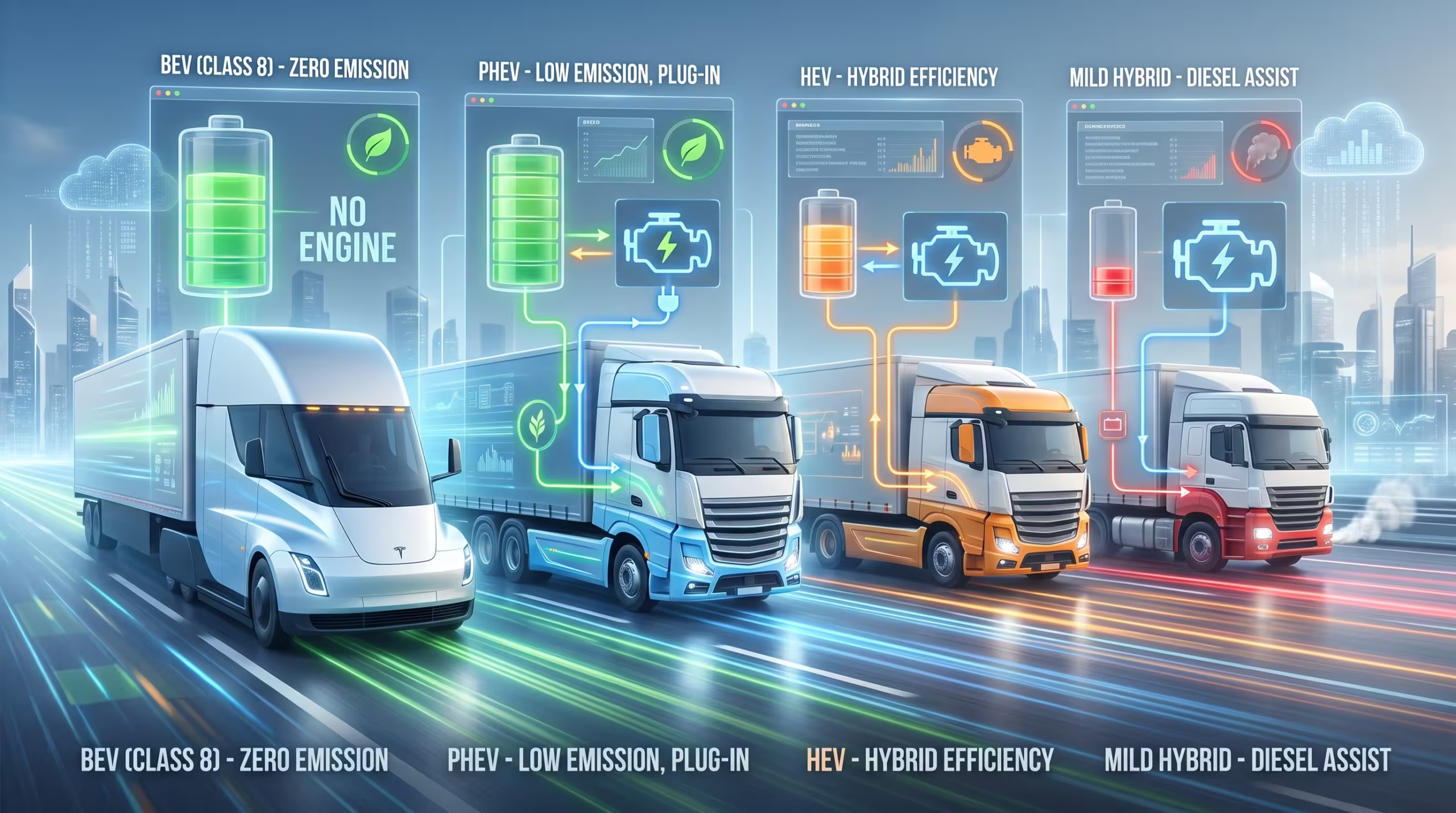
Before examining the engineering marvel of the Tesla Semi, it is essential to understand the broader context of modern electrification and what EV and hybrid vehicles are. The distinction between various electrified powertrains dictates their specific use cases and environmental impacts. An electric vehicle (EV), like the truck we are exploring today, relies entirely on large battery packs and electric motors for propulsion, producing absolute zero tailpipe emissions.

In contrast, a hybrid electric vehicle combines a traditional internal combustion engine with a small electric motor to improve overall fuel economy. Digging deeper into the hybrid spectrum, a plug-in hybrid electric vehicle (PHEV) features a larger battery that allows for a limited all-electric driving range before the gas or diesel engine takes over. Meanwhile, a mild hybrid uses a small electric generator merely to assist the combustion engine during heavy acceleration, reducing fuel consumption but never driving on electricity alone. In the heavy-duty logistics sector, hybrid models have served as a temporary stepping stone, but pure EVs represent the ultimate destination for long-term sustainability, mechanical simplicity, and operational cost reduction.
Tesla Semi Performance and Engineering
When evaluating any commercial freight vehicle, performance details dictate its real-world viability. The powertrain of this electric truck is nothing short of extraordinary. Driven by three independent carbon-sleeved electric motors located on the rear axles—using components directly shared with the high-performance Cybertruck platform—the vehicle is engineered for relentless power.

Horsepower and Torque
The tri-motor setup produces a staggering estimated 1,072 horsepower (up to 800 kW of drive power). This massive output provides instantaneous torque, meaning there is zero shift delay or turbo lag when accelerating. Unlike a traditional 18-wheeler that struggles to climb hills, the electric drivetrain maintains full 65-mph highway speed limits on steep 6% inclines where traditional diesel semi-trucks typically drop down to a sluggish 30 mph.
EV Range and Battery Capacity
Fleet operators demand reliability over long distances, making EV range a critical factor. The Tesla Semi is offered in two primary configurations: a Standard Range variant capable of traveling approximately 325 miles per charge, and a Long Range variant capable of reaching up to 500 miles. These range figures are achieved while fully loaded at an 82,000-pound maximum gross combination weight. While official battery capacity numbers are closely guarded, industry analysis indicates the Long Range model utilizes a massive battery pack ranging from roughly 850 kWh to 900 kWh, allowing it to achieve a highly efficient 1.7 kWh per mile energy consumption rate.
Charging Speed and Charging Time
A major hurdle for electric trucking is downtime, but advanced infrastructure is solving this issue. Equipped with MCS 3.2 connectivity, the truck utilizes the proprietary Megacharger network. This system operates at 1.2 MW charging speeds, allowing the massive battery to recover up to 60% of its total capacity in just 30 minutes. This rapid charging time perfectly aligns with legally mandated commercial driver rest breaks, ensuring that the vehicle spends more time on the road and less time tethered to a station.

Interior Technology and Driver Experience
The interior technology of the Tesla Semi completely rethinks commercial vehicle ergonomics. Drivers report an overwhelmingly positive shift in daily driving comfort compared to conventional commercial rigs.
Centered Seating and Ergonomics
Instead of the traditional left-side driving position, the cabin features a centrally located driver seat. This unique layout optimizes forward visibility and completely eliminates traditional left-side blind spots during complex yard maneuvers. While the center seating ergonomics complicate manual documentation hand-offs at security checkpoints slightly, drivers widely praise the panoramic view of the road.
Infotainment and Driver-Assistance Features
Flanking the steering wheel are dual 15-inch touchscreen displays that serve as the command center. These screens handle all infotainment features, navigation routing, and vehicle diagnostics. High-definition feeds from side-mounted cameras replace traditional bulky mirrors, actively reducing aerodynamic drag while enhancing safety. Furthermore, the vehicle is equipped with advanced driver-assistance and safety features, including automatic emergency braking, lane-keeping assist, and a sophisticated traction control system that utilizes independent motor torque vectoring to prevent jackknifing under extreme weather conditions.

Real-World Usability and Driving Experience
Transitioning from a rumbling diesel engine to a silent electric motor profoundly changes the driving experience. Veteran truckers note that the Tesla Semi drives much like a conventional passenger car despite its massive footprint. Independent front suspension and a smooth, single-gear electric drive eliminate the physical toll of continuous manual shifting and excessive cabin vibration. This physical stress relief translates to safer, more alert drivers during long-haul routes. However, operators have pointed out some practical challenges. The current cabin design lacks a sleeper berth configuration, which currently restricts the truck’s deployment primarily to regional, daytime slip-seat operations rather than cross-country overnight hauls.

Pricing, Availability, and Market Impact
Understanding the financial structure of heavy-duty EVs is vital for fleet adoption.
Pricing and Availability in the USA and Europe
As volume production ramps up at Gigafactory Nevada, current pricing targets place the Standard Range model at approximately $260,000 and the Long Range model at roughly $290,000. In the USA, federal tax credits under the Inflation Reduction Act can shave up to $40,000 off the purchase price, making it highly competitive. Currently, availability in the USA is restricted to major corporate fleets as production scales. Availability in Europe remains in the planning phases, as the current cab design and length must undergo strict homologation to meet European Union commercial vehicle dimensional regulations.
Ownership Cost and Maintenance Cost
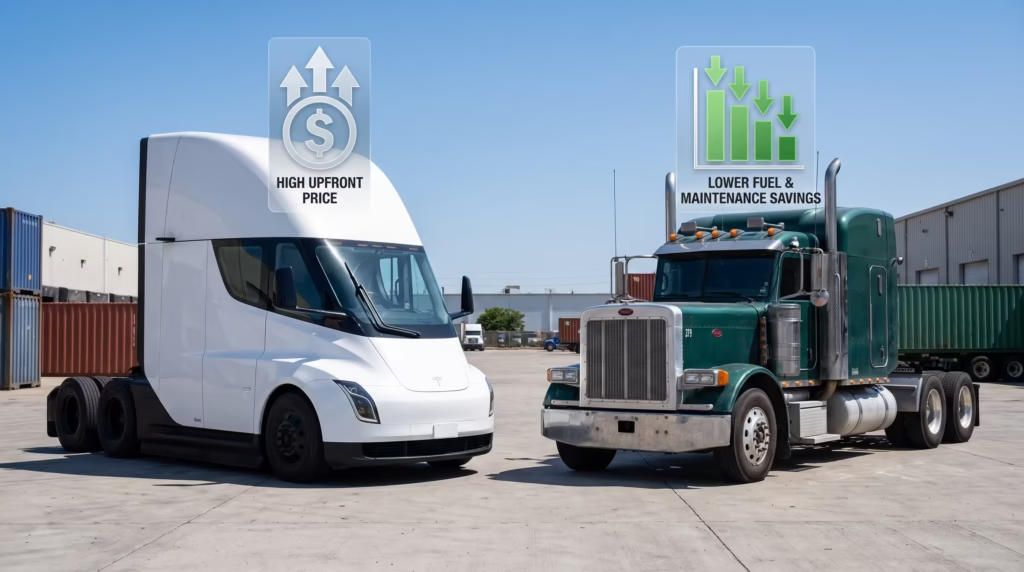
The commercial value proposition relies on rapid operational cost recovery. The Tesla Semi offers fuel economy and efficiency that diesel cannot match. Fleet testing details a significant reduction in required mechanical maintenance hours due to the overall mechanical simplicity of the electric drivetrain. There are no oil changes, no transmission rebuilds, and no diesel exhaust fluid (DEF) systems to maintain. Furthermore, aggressive regenerative braking handles the vast majority of deceleration, extending the life of physical brake pads almost indefinitely.
Comparison Electric vs Traditional Diesel Trucks
| Feature | Tesla Semi (Long Range) | Traditional Diesel Class 8 Truck |
| Powertrain | Tri-Motor Electric | Inline-6 Turbo Diesel |
| Horsepower | ~1,072 HP | 400 – 600 HP |
| Energy Cost | ~$0.17 – $0.31 per mile | ~$0.60 – $0.70 per mile |
| Emissions | Zero Tailpipe Emissions | High CO2 and NOx Emissions |
| Transmission | Single-Speed Direct Drive | 10 to 18-Speed Manual/Auto |
| Refueling Time | 30 minutes (60% charge) | 15 minutes (Full tank) |
Environmental Impact and Future Trends
The environmental impact of shifting commercial logistics to battery electric vehicles cannot be overstated. Heavy-duty trucks account for a disproportionate amount of highway emissions. By electrifying just a fraction of the global freight fleet, the reduction in greenhouse gases is massive. As charging infrastructure deficits are slowly resolved with localized hub-and-spoke routes and expanding commercial public networks, the Tesla Semi is poised to dominate regional transport.
The market impact and future trends point clearly toward mandatory decarbonization. Competitors like Volvo, Freightliner, and Nikola are rapidly advancing their own electric and hydrogen hybrid fleets, but the aggressive pricing, unmatched software integration, and vast Supercharger network backing give this electric truck a distinct edge.
Key Specifications Section
| Specification | Standard Range Model | Long Range Model |
| Gross Combination Weight | 82,000 lbs | 82,000 lbs |
| Estimated Range | 325 miles | 500 miles |
| Energy Consumption | ~1.7 kWh per mile | ~1.7 kWh per mile |
| Charging Capability | Up to 1.2 MW (MCS) | Up to 1.2 MW (MCS) |
| Powertrain | Tri-Motor Rear Axle | Tri-Motor Rear Axle |
| 0-60 mph (Fully Loaded) | ~20 seconds | ~20 seconds |
| Estimated Base Price | $260,000 | $290,000 |
The Tesla Semi is no longer a concept; it is a commercial breakthrough shifting the expectations of heavy-duty logistics. From its tri-motor performance details to its profound physical stress relief for drivers, it proves that zero-emission freight is both technologically possible and financially viable. While public charging infrastructure remains a hurdle for immediate cross-country deployment, the economic fuel savings and reduced maintenance costs create an undeniable value proposition for regional fleets.