Honda CBR1000RR ABS Review The Legendary Fireblade Delivers Track-Ready Performance with Everyday Usability


Welcome to our comprehensive Honda CBR1000RR ABS review, where we dive deep into one of the most legendary motorcycles ever built. If you are a speed lover, a dedicated track rider, or a superbike enthusiast, you already know the legacy of this machine.
Affectionately known worldwide as the “Fireblade,” this motorcycle has carved out a massive reputation for balancing extreme track performance with everyday street usability. The CBR1000RR is not just a motorcycle; it is a statement of engineering precision from Honda.
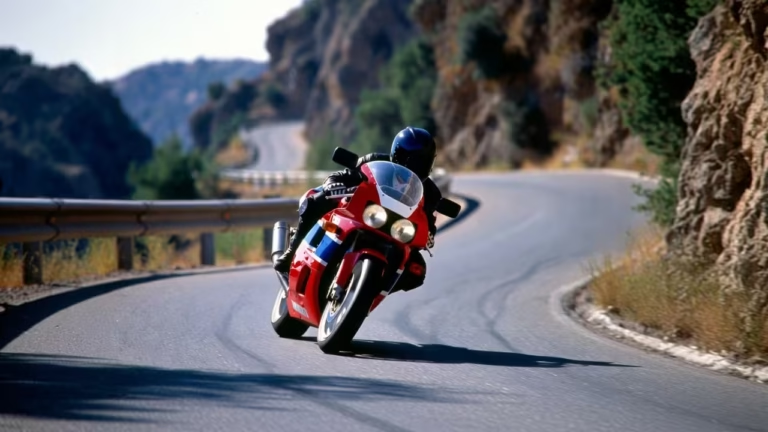
Whether you are carving through the canyons in California or navigating the sweeping mountain passes of Europe, the Fireblade promises an adrenaline rush like no other. In this detailed guide, we will explore everything from its blistering acceleration to its advanced electronics.
By the end of this article, you will know exactly why this machine frequently ranks as the best superbike under 1000cc for riders who value control as much as power. Let’s twist the throttle and explore the Fireblade in all its glory.
A Complete Honda CBR1000RR Overview
The history of the Fireblade dates back to 1992 with the revolutionary CBR900RR, a bike that changed the superbike landscape by proving that lighter weight could beat pure, heavy horsepower. Over the decades, Honda has meticulously refined this philosophy.
Today’s CBR1000RR ABS carries that lightweight, mass-centralized DNA but injects it with modern aerodynamics and cutting-edge rider aids. Compared to earlier iterations, the current generation is drastically lighter, more powerful, and significantly smarter thanks to its Inertial Measurement Unit (IMU).
Positioned fiercely in the fiercely competitive liter-bike segment, the Fireblade faces off against some heavy hitters. It goes toe-to-toe with the ferocious Yamaha YZF-R1, the championship-winning Kawasaki Ninja ZX-10R, and the universally loved Suzuki GSX-R1000.
While its rivals often chase peak horsepower numbers that look good on a spec sheet, Honda focuses on “Total Control.” This means the Fireblade is designed to make the rider faster, safer, and more confident, rather than just strapping them to a rocket.
Engine & Performance: The Heart of the Beast
At the core of the Fireblade is a liquid-cooled, 999cc inline-four engine that is a marvel of modern engineering. This powerplant is designed to deliver a massive punch without intimidating the rider, generating around 189 horsepower and 114 Nm of torque.
Consequently, the acceleration is mind-bending. The bike rockets from 0 to 100 km/h in just under 3 seconds. For those wondering about the CBR1000RR top speed, it is electronically limited to 299 km/h (186 mph), placing it firmly in the upper echelons of global superbikes.
Throttle response is surgically precise thanks to Honda’s Throttle by Wire (TBW) system. Unlike the abrupt, snappy power delivery found on some aggressive Italian rivals, the Honda rolls on power with a buttery smoothness.
However, do not mistake smoothness for weakness. When you push the tachometer past 8,000 RPM, the inline-four screams, delivering a relentless surge of power all the way to its redline.
Track Day vs. Street Riding Dynamics
On the track, this smooth power delivery translates to better tire life and the ability to get on the gas earlier exiting corners. You can dial in the exact amount of power you need while leaned over.
On the street, the real-world riding experience is sublime. The midrange torque is beefy enough that you don’t need to constantly shift gears to pass traffic on the highway. It behaves impeccably at low speeds, a rarity in the liter-bike class.
Advanced ABS & Electronics Package
Modern superbikes require serious computational power to keep riders safe, and the Fireblade delivers. The ABS on this motorcycle is not a standard system; it is a lean-angle-sensitive, gyro-assisted marvel.
It calculates the bike’s pitch and roll in milliseconds, distributing braking force between the front and rear wheels to prevent wheel lockup without upsetting the chassis. The benefits for safety are monumental, especially during panic braking in a corner.
Furthermore, the bike features a sophisticated Traction Control System (Honda Selectable Torque Control). It seamlessly limits rear-wheel slip to keep you moving forward rather than sideways.
Riders can choose from multiple riding modes (Track, Sport, Rain, and Custom), adjusting power delivery, engine braking, and traction control on the fly. Additionally, the Honda Electronic Steering Damper (HESD) automatically adjusts damping force based on your speed, preventing tank slappers.
Beginner vs. Pro Rider Benefits
For newer liter-bike riders (though beginners should avoid 1000cc bikes entirely), these electronics act as a vital safety net, forgiving minor mistakes. For pro riders, the system is refined enough to fade into the background, allowing them to push closer to the edge without intrusive electronic interference.
Design & Styling: Form Follows Function
Honda engineered the CBR1000RR with an aggressive, aerodynamic design strictly focused on cutting through the air with minimal drag. Every fairing curve and intake vent serves a performance purpose.
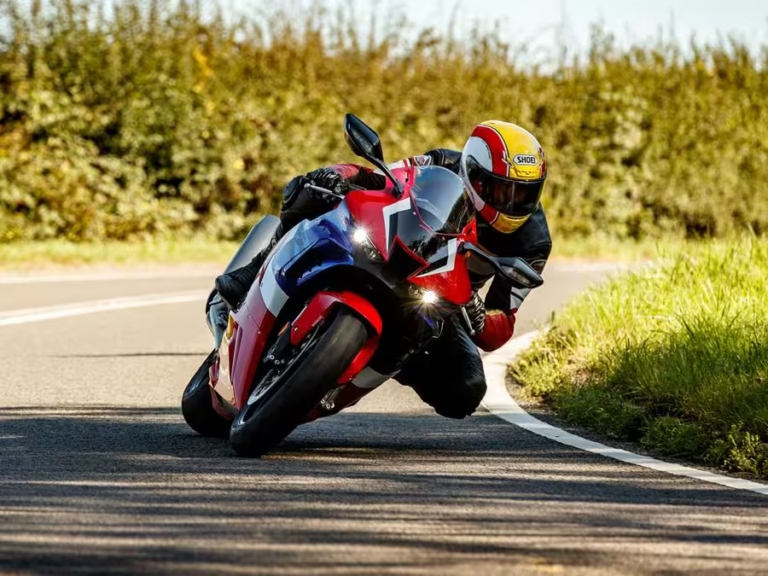
The front fascia is dominated by sharp, dual LED headlights that give the bike a predatory look while providing brilliant nighttime illumination. Behind the front cowl, the fuel tank is ergonomically sculpted with deep knee cutouts.
Your riding posture is undeniably aggressive, pushing your weight over the front wheel for maximum feel and control. However, it manages to be slightly more forgiving than extreme track-only weapons.
When you compare its design philosophy with the Ducati Panigale V4, the difference is clear. The Ducati is an exotic, flashy piece of rolling art. The Honda, while beautiful, is a study in functional, restrained Japanese precision.
Comfort & Ergonomics: Can You Tour on It?
Let’s be clear: this is a supersport, not a Gold Wing. However, within its class, the Fireblade is surprisingly accommodating. The seat height sits at an accessible 32.8 inches (833 mm).
The riding position features clip-on handlebars that are relatively wide and footpegs that aren’t brutally high. This triangle allows for decent comfort on shorter weekend blasts.
For long highway rides across the USA or Europe, you will eventually feel the strain in your wrists and lower back. Wind protection is adequate, provided you tuck in tightly behind the windscreen.
Handling & Ride Quality: The Ultimate Corner Carver
Handling is where the Fireblade truly earns its legendary status. The lightweight twin-spar aluminum chassis acts as the perfect skeleton, offering incredible rigidity without sacrificing feedback.
Suspension duties are handled by fully adjustable Showa Big Piston Forks (BPF) at the front and a Showa Balance Free Rear Cushion (BFRC) shock at the rear. This setup eats up mid-corner bumps effortlessly.
Cornering ability is telepathic. You simply look where you want to go, shift your weight, and the bike intuitively drops into the lean.
At high speeds, the aerodynamic downforce and electronic steering damper provide rock-solid stability. Whether you are attacking apexes on a track day or carving up a mountain road, the ride quality inspires massive confidence.
Braking System: Stopping on a Dime
Stopping a 189-horsepower missile requires serious hardware. The Fireblade uses dual 320mm floating discs up front clamped by high-performance radial-mount Tokico calipers.
This braking system provides phenomenal initial bite and progressive feel through the lever. As highlighted earlier in this Honda CBR1000RR ABS review, the ABS system shines brightest here.
In dry conditions, you can brake incredibly late into a corner, with the ABS only intervening at the absolute limit of grip. Emergency braking confidence is unparalleled.
In wet conditions, the system is a lifesaver. It modulates brake pressure perfectly, ensuring the front tire maintains traction even on slick tarmac. This is arguably one of the most critical safety features on the entire motorcycle.
Fuel Efficiency & Mileage Expectations
If you are buying a liter-class superbike, fuel economy is likely at the bottom of your priority list. The 999cc engine is thirsty when ridden hard.
On average, the CBR1000RR mileage hovers around 15-17 km/l (35-40 MPG) during mixed highway and city riding. If you take it to the track, expect that number to drop significantly.
With a fuel tank capacity of 16.2 liters (4.3 gallons), you can expect a realistic range of roughly 240 kilometers (150 miles) before the low fuel light demands your attention. Always plan your gas stops accordingly on long rides!
Read More:-
- Honda CBR1000RR SP2 Review (2026): Specs, Top Speed, Price & Performance
- Honda CBR1000RR SP2 Review: An In-Depth Look at the Track-Focused Superbike
Exhaust Sound & Riding Feel
Press the starter button, and the inline-four wakes up with a deep, menacing growl. The stock exhaust sound profile is heavily muffled at idle to meet Euro 5 emissions standards.
However, once you bypass 6,000 RPM, an exhaust valve opens up, and the bike unleashes a spine-tingling, high-pitched howl. It is an incredibly emotional riding experience.
When you compare it with rivals, it lacks the raw, uneven grumble of the Yamaha R1’s crossplane crank. Yet, there is something undeniably pure and classic about the high-revving scream of a traditional Japanese inline-four.
Price & Availability
Pricing for the Fireblade positions it as a premium offering in the superbike market. In the USA and European markets, the global price range typically sits between $16,500 and $17,000 for the standard ABS model.
Maintenance costs are standard for the liter-bike class, but spare parts availability is generally better than European brands thanks to Honda’s massive global dealership network.
Maintenance & Reliability: The Honda Promise
When you buy a Honda, you are buying peace of mind. The brand’s reliability reputation is second to none in the motorcycle world.
Service intervals are relatively generous. Basic oil and filter changes are recommended every 8,000 miles (12,000 km), while major services like valve clearance checks happen at 16,000 miles (24,000 km).
Common issues are incredibly rare on this generation of the Fireblade. The cost of ownership over a five-year period is typically much lower than its Italian or German counterparts, cementing its status as a highly practical exotic.

Pros and Cons
Every motorcycle has its strengths and weaknesses. Here is a quick breakdown.
Pros:
- Exceptionally smooth and controllable power delivery
- Class-leading agility and excellent handling
- Bulletproof reliable engine
- Strong braking performance with lean-sensitive ABS
Cons:
- Expensive initial purchase price
- Absolutely not beginner-friendly
- Low fuel efficiency limits touring range
Honda CBR1000RR vs Competitors
To see how the Fireblade stacks up against the competition, check out this quick comparison table:
| Feature | Honda CBR1000RR | Yamaha YZF-R1 | Kawasaki ZX-10R | Suzuki GSX-R1000 |
| Power | 189 HP | 198 HP | 203 HP | 199 HP |
| Weight | 432 lbs (Wet) | 448 lbs (Wet) | 456 lbs (Wet) | 445 lbs (Wet) |
| Electronics | IMU, ABS, HSTC | IMU, Slide Control | IMU, Launch Control | IMU, Motion Track |
| Est. Price | ~$16,500 | ~$17,999 | ~$17,399 | ~$16,149 |
Note: Prices and specs may vary slightly by region and model year.
Who Should Buy This Bike?
The target audience for the CBR1000RR is highly specific. It is built for dedicated track riders who want a reliable weapon for weekend racing.
Experienced bikers looking to upgrade from a 600cc supersport will find the Honda’s predictable power delivery to be the perfect stepping stone into the liter class. It is for performance lovers who appreciate engineering finesse.
Let us reiterate: this bike is not ideal for beginners. The sheer power and aggressive geometry require experienced throttle control and advanced riding skills to operate safely.
Real User Experience / Reviews
Rider feedback globally praises the Fireblade for its usability. “It feels like a 600cc bike with the heart of a monster,” says one track test impression from a professional rider in California.
Daily riding opinions highlight its manageable low-speed fueling. While it runs a bit hot in dead-stop traffic, owners frequently cite how beautifully balanced the bike feels under all conditions, giving them supreme confidence in the twisties.
Specifications Table
For a quick look at the Honda Fireblade specs, here is the technical data:
| Specification | Detail |
| Engine | 999cc Liquid-Cooled Inline-Four |
| Power | 189 Horsepower @ 13,000 RPM |
| Torque | 114 Nm @ 11,000 RPM |
| Weight (Wet) | 432 lbs (196 kg) |
| Fuel Capacity | 4.3 Gallons (16.2 Liters) |
| Seat Height | 32.8 Inches (833 mm) |
| Transmission | 6-Speed with Assist/Slipper Clutch |
FAQs
Is Honda CBR1000RR good for beginners?
Absolutely not. With nearly 190 horsepower, hyper-sensitive brakes, and an aggressive riding stance, this motorcycle requires advanced riding skills. Beginners should start on bikes like the CBR300R or CBR500R.
What is the top speed of the Fireblade?
The CBR1000RR top speed is electronically limited to 299 km/h (186 mph), in accordance with the gentlemen’s agreement among global motorcycle manufacturers.
Is ABS worth it on a superbike?
Yes. The cornering ABS on the Fireblade uses an IMU to prevent wheel lockup even when the bike is leaned over. It is a vital safety net that saves lives on the street and prevents crashes on the track.
What is the mileage in real life?
In real-world conditions combining highway and city riding, you can expect around 35 to 40 MPG (15-17 km/l). Aggressive track riding will reduce this number significantly.
What is the difference between CBR1000RR and CBR1000RR-R?
The CBR1000RR-R (Fireblade SP) is a more extreme, track-focused homologation special. It produces more horsepower (over 210 HP), features integrated aerodynamic winglets, premium Öhlins electronic suspension, and Brembo Stylema brakes, but it comes at a much higher price tag.
Final Verdict
Wrapping up this Honda CBR1000RR ABS review, it is clear that Honda has mastered the art of building a user-friendly superbike. We give this motorcycle an overall rating of 4.5 out of 5 stars.
It is best suited for experienced sportbike riders who value agility, reliability, and smooth power delivery over raw, unmanageable peak horsepower. In terms of value for money, it undercuts many of its European competitors while offering unmatched reliability.
If you want a motorcycle that will dominate track days on Sunday and still commute reliably on Monday, the Fireblade remains an absolute legend. Head down to your local Honda dealer and book a test ride today!
Explore EVs, Cars & Bikes:-